
 |
(...)
DOMINIQUE VILLAIN: On Corneille-Brecht (2009), for example, how did this work with these texts come about?
JEAN-MARIE STRAUB: It was an actress — Cornelia Geiser — who had seen Sicilia!. I think it was the first film of ours she'd seen. She knew that we work on texts before making a film, and she wanted to do this work, independently of the cinema or a film. She had no idea for a text. I ended up accepting when she insisted. One fine day, after five or six years, I said to her "Here you go".
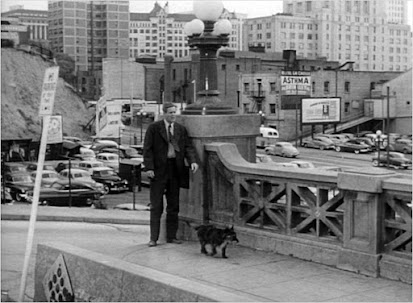
And then suddenly, I found myself in the hospital, because I was run over by a Vespa while crossing the Caulaincourt bridge at half past midnight. The result was four small pieces. In the hospital I didn't know how to occupy myself. She sometimes came to see me, I said to her: “Sit down, we will finally do the work together”.
I offered her two little monologues by Corneille, and after we worked on them a bit, after a few weeks, I liked her because her mother tongue is German. She's from the Munich region. I thought it would be nice to give her a text in German as well. I remembered a sentence that was going around in my head, which I had, moreover, changed around. It was the sentence: "Rom, Rom, Rom, Was ist das Rom?" I knew it was by Brecht and that I'd heard it at the Berliner Ensemble in the fifties. I didn't even know which Brecht play it came from. I wracked my brain, and I found where it appeared: in what's called in French “Le Procès de Lucullus” ("The Trial of Lucullus"). Which is both a Dessau opera, a radio text and a play.* I found my sentence, but it wasn't my sentence, it was "Rom, Rom, was ist Rom?"


DOMINIQUE VILLAIN: Yes, can you talk more specifically about working with the actress?
In general, professional actors do not know how to breathe. Even those from the famous Schaubühne in Berlin. We worked with them for three months. After three months, I said to them: “But nobody taught you how to breathe?" They said no. They have piano lessons every day, but they didn't understand when we told them to make an arc until there, to stop only after such and such a word, to start again at the next line, to breathe three, four, or five times... We make bars. A bar at the end of a line, or two bars, or five bars. This means: 1, 2, 3, 4, at 5 we go to the next line. Once it's decided, depending on the logic of the text, the syntax, and the dynamic that we're trying to capture or produce, it becomes a kind of score that each actor is obliged to exercise, instead of improvising. It involves preventing them from emptying their heart and soul and trampling on the text, from using the text as a springboard to express their personal petty bourgeois sentiments.
I should have brought you the text of the latest film, which is not this film, but a little after, in Italian. You would have seen that the text is retyped horizontally. Already, it's an attack on Mr. Gutenberg, because the book, obviously, must be vertical. Even among Arabs or Hebrews who read the other way. We make the page horizontal. To have room for longer lines. A line consists of several small sentences or a very large sentence that makes up several lines in the book. You need something visual, for the actor. At the end of the line we put bars, as I said. Then we put signs. The actor discovers the text, there's a key word in the middle of the text. He says this key word as if it didn't exist. So, we ask him shyly: “Do you know what this word means, do you know the weight of this word?” He replies: “Ah! I didn't think about it!" or he says nothing. We then say to them: “Without any intention, or without emphasizing, think of the weight of this word, and re-read the text to me." And there the word exists. Without vocal effect, the word has passed through the brain, through the heart, and through the nerves, and, by the grace of God — donnée par surcroît — it gains weight, it has its weight. That's the work. So, we mark a red line or a green line, gradually there are layers. There are blue, brown, black, purple marks. It becomes a score that needs to be exercised, exercised. Like a musician practices a score.
The first two texts in French that we had worked on were about Rome, I wanted to settle accounts with the city of Rome, which I hate, although I had a certain love for it at the start. I learned to hate it. The first text ended with: "Voir Rome etcetera... moi seul en être témoin et mourir de plaisir" ("Take Rome etcetera... I alone will be the cause of it and die of pleasure"). It was Horace, which I barely knew, I'd read it fifty years before, in high school. The second text is a little monologue that I took from a play that dates from 1667 (Othon), by the same Corneille, written more than thirty years later. So, we saw different layers. We had the work of a relatively young man, and the work of the same man thirty years later. And who, in the meantime, had translated thousands of verses from Latin and The Imitation of Jesus Christ. It was important, there were two stages, two strata by the same author. And it was about the horrors of the Roman Empire.
While working on these texts, I thought of Brecht's phrase, the origin of which I'd forgotten. I found it, and I told this actress that we could work on that too. It got a lot longer, even though it's not a very long movie. The two texts in French caused a third. We worked on this text by Brecht. But I was far from the cinema. I was interested in this young lady, who wanted to work. I was interested in seeing what she was capable of, and what she would be capable of if pushed or held back.
She was seated in front of a white wall. I was lying on my hospital bed sitting next to her. We talked a bit. And after two months, I said to myself that what she was doing, after all, it would be interesting to film it. It would be a film that wouldn't be a film, but what we would film would be interesting, and ninety percent different from other films.
At that moment, I was kicked out of the hospital. Social Security stopped paying. I ended up at my house, rue Cavallotti near Place Clichy, and instead of having a white wall, I had strange things. I filmed where I've lived in Paris since 1954. The Corneille passages, in front of an open window. She turns her back to the street. For the other text, she's seated in a crumbling armchair with a red throw cover. Between the blocks of Brecht, we introduced punctuation. Each time there's a break, and between each shot, she changed her costume. With Danièle, we always made fun of contemporary French films made by Fémis students or by more famous people. Real fashion shows, where the main actress changes her costume with each shot. We said to ourselves: “Another fashion show, dull as dishwater." Here, I wanted to do that squarely. She changed her blouse and skirt with each shot. With violently different colors. As it's in semi-darkness and the colors are violent since everything isn't illuminated, this creates violent shocks. But anyway it's a beautiful fashion show. (To Dominique Villain) Is that what you wanted to know?
STRAUB: It's the work anyone should do with any text. Whether their name is Straub or Tartampion. We read a text, we see that some people have introduced punctuation that didn't exist, or have falsified it. We try to dynamite the punctuation by returning to a form of oral culture. You have to know where you breathe. After dynamiting a comma, a period, we continue, and we go to the next line only later, after such and such a speech, a word, a verb, a complement. To give the text a dynamic which corresponds to the individual who says it, to their personal breath.
In general, professional actors do not know how to breathe. Even those from the famous Schaubühne in Berlin. We worked with them for three months. After three months, I said to them: “But nobody taught you how to breathe?" They said no. They have piano lessons every day, but they didn't understand when we told them to make an arc until there, to stop only after such and such a word, to start again at the next line, to breathe three, four, or five times... We make bars. A bar at the end of a line, or two bars, or five bars. This means: 1, 2, 3, 4, at 5 we go to the next line. Once it's decided, depending on the logic of the text, the syntax, and the dynamic that we're trying to capture or produce, it becomes a kind of score that each actor is obliged to exercise, instead of improvising. It involves preventing them from emptying their heart and soul and trampling on the text, from using the text as a springboard to express their personal petty bourgeois sentiments.
I should have brought you the text of the latest film, which is not this film, but a little after, in Italian. You would have seen that the text is retyped horizontally. Already, it's an attack on Mr. Gutenberg, because the book, obviously, must be vertical. Even among Arabs or Hebrews who read the other way. We make the page horizontal. To have room for longer lines. A line consists of several small sentences or a very large sentence that makes up several lines in the book. You need something visual, for the actor. At the end of the line we put bars, as I said. Then we put signs. The actor discovers the text, there's a key word in the middle of the text. He says this key word as if it didn't exist. So, we ask him shyly: “Do you know what this word means, do you know the weight of this word?” He replies: “Ah! I didn't think about it!" or he says nothing. We then say to them: “Without any intention, or without emphasizing, think of the weight of this word, and re-read the text to me." And there the word exists. Without vocal effect, the word has passed through the brain, through the heart, and through the nerves, and, by the grace of God — donnée par surcroît — it gains weight, it has its weight. That's the work. So, we mark a red line or a green line, gradually there are layers. There are blue, brown, black, purple marks. It becomes a score that needs to be exercised, exercised. Like a musician practices a score.


Horizontal pages from
IL GINOCCHIO DI AREMIDE (2008)
and UN HÉRITIER (2011)
A STUDENT: For the texts by Corneille and Brecht, did you give the actress any indications as you worked on the rhythm, the intonations, the musical punctuation, the breathing? Do you also happen to say the text aloud yourself?
STRAUB: No no. I am careful not to tell them: “Listen to me, you are going to imitate what I am going to do.” It comes slowly, unconsciously. For example, when she begins to sing a small block three times in a somewhat bizarre way for an actress, it was found slowly. Neither she nor I had the idea of saying, "Here, we're going to start singing."
Everything is born par surcroît. Or by chance... Great art comes from chance, it does not come from intentions.
But there is a construction, when you make a film. The minimum work that one must demand of oneself as the so-called author of the film, even before working on the text, before filming, before discovering places and taming them, is to discover a construction. Without construction, nothing exists, in art even less than elsewhere. No more than there is a soul apart from a body.
A STUDENT: Do you sometimes remove certain sentences or certain passages?
STRAUB: No no. When I censor in the middle of a text, it's very rare, it's to prevent the author from putting on a bad face. In a letter from Schoenberg to Kandinsky, I took the liberty of removing the sentence: "There will always be wars, we can't do anything about it, we just have to let it happen." I said to myself that it was a cliché unworthy of Schoenberg, so I cut it.
I hate theater directors who put on a play by a famous author, and who remove all sorts of little phrases here and there that they don't like. The work on a text must precisely consist of understanding it slowly, and in discovering, even after having understood or while understanding it, things that at the starting point shocked you, provoked you, and which did not please you. Which were not pleasant or which were even unpleasant. Above all, there should be no censorship.
The only censorship permitted is Stalinist censorship.
DOMINIQUE VILLAIN: Based on this film, I would like to come back to the idea of construction. Is it the montage of the two texts that you call the construction? Could you have built a film from a single element, for example, Brecht's text? Or must there always be two or more elements...
STRAUB: In this case, I can't answer this question, because it was not a film at the start. So, I didn't do my job beforehand. I only did it at the last minute. I did it before filming, but I didn't do it three months, ten years, or three years before, since I had no intention of making a film. It happened like that. She was happy to have worked on these two little blocks by Corneille, and when I found the Brecht text, which had been like a ghost in my head for twenty years, there were three blocks which, without yet being a construction, formed a subject for a possible film, which may not be a film. It's different from our other films.

Excerpts from an interview
with Jean-Marie Straub,
Le Travaille du cinéma I
by Dominique Villian
PU Vincennes, 2012.
Translated by Andy Rector.

*Brecht wrote The Trial of Lucullus quickly, in two weeks while in exile in Sweden in 1939, as if out of historical necessity. Later, in 1951, when he and Paul Dessau were working on the opera version of the play in East Germany, they ran into production delays when the GDR Ministry for Popular Education accused their libretto of formalism and pressed for revisions to counter its perceived elements of pacifism. Brecht wrote: "i'm against this (delay). the subject is important just at this moment, when the americans are issuing such hysterical threats," referring to Truman's order of American troops into Korea in '50-51 under cover of the U.N., after North Korea's invasion of the South, while General Douglas MacArthur was advocating for the use of atom bombs against Korea. The opera was retitled The Condemnation of Lucullus. ––A.R.
Barbara Brecht-Schall quoting Brecht on the GDR:


"I have my opinions not because I am here;
rather I am here because I have my opinions." –b.b.