Excerpts from the
Interview with Jean-Luc Godard
“ARDENT HOPE”
by Stéphane Delorme and Joachim Lepastier,
Les Cahiers du Cinéma, no. 759, October 2019.
The full Cahiers interview and issue can be found here.
Translated by Srikanth Srinivasan & Andy Rector
With thanks to Craig Keller and Bill Krohn
Interview with Jean-Luc Godard
“ARDENT HOPE”
by Stéphane Delorme and Joachim Lepastier,
Les Cahiers du Cinéma, no. 759, October 2019.
The full Cahiers interview and issue can be found here.
Translated by Srikanth Srinivasan & Andy Rector
With thanks to Craig Keller and Bill Krohn

Unless otherwise captioned, the images in this interview
were sent by Godard to the Cahiers from his phone
JEAN-LUC GODARD: ...we’re not going to talk about the Théâtre des Amandiers. I’ve no idea what happened there. Nicole Brenez is taking care of it. I wanted to see you, actually. It’s a bit like seeing the great grandchildren of Cahiers du cinéma. I was curious to see what became of them.
CAHIERS DU CINÉMA: We were very moved, stunned even, by the film at Cannes, especially the whole ending with “ardent hope” that gave a meaning to this journey through the ruins. The entire first section on the eternal remake of war, then Joseph de Maistre who explains that war is a universal law of nature, then the law of men that seems to restore order, but which, in fact, is an injustice… The film goes forth in the night and you lead us into the light. It burns, but it burns differently.
JLG: Yes, I must tell you that we speak the same language. When I say the same language, I don’t mean French rather than Chinese or Finnish. Generally speaking, in the past few films, I’ve been making a distinction between langue and langage1. This was after I read a book on langage by a German sociologist, Fritz Mauthner, written around 1910, which severely reproaches langue itself. He calls it langage, like everyone else. But I see a distinction, owing to an influence of painting, with respect to langue, which is more or less texts and words. I’ve been wary of their perversity for a long time. There’s a line by Péguy that I put in Histoire(s) du cinéma: “We can say anything except to say what we do.” What I call langage, and which everyone confuses with langue, is an act. For now, cinema is a true repository, but doesn’t really want knowledge. And that irritates me too because I speak the langue (laughs). Between us, it’s a swamp of perversity. Langage is a kind of engagement between image and speech2. But speech is not what langue means when it uses the term “parole”, even in Heidegger. The beginning of Anne-Marie Miéville’s last film (After the Reconciliation, ed.) shows the langage of women in 18th century costumes in a forest, who read out a text by Heidegger, On the Way to Language. All the literature I love—which they still call “the great writers”, but don’t say why they are great, Duras, Dostoevsky, Hölderlin, Daniel Dafoe, Melville—the entire effort of what is called “great literature”, Joyce or Rimbaud, they admit it themselves, is to try to push what they call langage, and I’m not there yet, just langue, to its last bastion. Something we can see with Flaubert in Bouvard et Pécuchet, which prefigures social networks and Facebook, all that data. Marie Darrieussecq said it in her own way when I tried to adapt her first novel (Pig Tales¸ ed.) and it didn’t happen because I felt that I had to describe it with langue and not with anything else, and that was impossible with a writer.
We’re going to speak a little in langue. I’ll respond to your questions through langue. I accepted your invitation to see, historically speaking, where the grandchildren or great grandchildren of Cahiers are (smiles). I’m sensitive to events, to historical currents, that are big, be it in China or Russia. I want to remind you that what we’re going to say is not what we read nor what will be printed. Langage is what’s behind, like the clouds in Delacroix’s watercolors. It’s what Baudelaire says in The Stranger: “I love the clouds, the marvelous clouds.” This question took shape in my last four or five films. I feel that there was a change in my work from In Praise of Love onwards, or from For Ever Mozart.
CDC: What happened?
CDC: You speak of langage as an act. In The Image Book, the action on the image is very visible.
JLG: Yes, I read it. She is unique. We can find that among certain actresses. Adèle Haenel has something but the films don’t measure up.
CDC: Given that you are wary of language today, do you draw inspiration more from silent cinema or early talkies?
JLG: No, not particularly. In Langlois’s time, we were trained to consider the Borzage film at the same time as a film by Garrel, Verneuil or Gilles Grangier. We were only three or four. Rivette, Rohmer, Truffaut and I.
JLG: It’s a text by Blanchot. I read his first book when I was very young, about 15-16, as I read other books that tried to go further, Nadja or Aragon’s Le Paysan de Paris. I tried to shoot a sequence with this text for Our Music, but it fell flat and we removed it. We had to make a fake-real 3D with the sound next to the image, and not in the image. It was in line with the real question of the “La région centrale” sequence. Bernard Eisenschitz asked me, “What’s la region centrale?” I told him, “Love, of course.” But few see it that way. They prefer talking about Michael Snow’s film.
JLG: For me, the second section, “Happy Arabia”, was a return to reality, I agreed to make a film that was a little flatter. You could say that the first section is more documentary, that the second section is completely fictional, made with actors I picked from films and who come from a novel. I saw the film twice more. The first time, I thought, “Ah, it’s too different. That’s too bad.” Now, I tell myself that it had to be bad. One is more flat. The sound is much more varied too. Television sound can’t make a distinction, like an orchestra that’s constantly asked to play different things at the same volume. The poor conductor is overwhelmed.
JLG: When the Russians lost to the German army, they went back on the offensive.One clearly sees the difference. The Germans were strong in simple tactics, but had little strategy, except Hitler’s, which was that of Alfred Jarry. On the other hand, the Russians could resume with a strategy different from the one they had, and which was practical too.
JLG: Yes, I’ll always be for the Russians. In Goodbye to Language, one of the young girls says: “If the Russians become part of Europe, they won’t be Russians anymore.”
JLG: No, I shot several endings. I prolonged it bit by bit because I wanted people to recall that they saw something other than Arabia. The final text comes from Peter Weiss’ The Aesthetics of Resistance.
JLG: No, but I knew him because he wrote the play Marat-Sade. I read the first three volumes of The Aesthetics of Resistance, 1,000 pages, for the film. It’s his story, from the Spanish War to the end, when he was a refugee in Sweden and used to meet Brecht, who was there too. I work a lot in parallel. News programs mention “in parallel” when they speak of perpendicular (laughs).
JLG: Yes, Persian carpets are very much like that. There are many swastikas in Persian carpets.
CDC: For example, what is one to make of the thread with Joseph de Maistre in The Image Book? He says, in these horrifying terms, that destruction is the universal law.
JLG: I didn’t know that at all. I came across him in an article. All that is incredible. And then, he was the French ambassador to St. Petersburg. I took it as an opportunity to speak about the war.

CDC: He even speaks about immolation. It’s a moment of despair, but also of irresponsibility, because humanity is overwhelmed by universal laws.
JLG: The Second World War is still widely studied from other points of view. I’m reading a hefty book at the moment, Barbossa, 1941, the Absolute War (by Jean Lopez and Lasha Otkhmezuri, ed.) on Germany’s attack on Russia. It’s just an opposition of texts, from soldiers’ diaries as well as official speeches: it’s just text against text. Every time Stalin utters a word, there are 10,000 deaths. Same with Hitler. I’m not speaking of horses, because the cavalry was still there. That’s why I show a falling horse from time to time.
JLG: Yes, it came little by little. I once had a dog that I really loved. Roxy reminded me of it. I gifted a dog to Anne Wiazemsky. There has always been something. At the moment, it’s animals. I’m all for the L214 association, without getting personally involved.
JLG: Between a dog and an actor, there’s no comparison. According to legend, God offered monkeys the power of speech. They said, “Certainly not.” We understand them. Their gestures still remain. Dogs are at the same time lost, kind, open, except when they are ready for war. I picked up the llama in Film Socialism after spotting it in a field ten kilometers from here. And donkeys, of course. I have a great admiration for Au hazard Balthazar, even if it’s not Bresson’s best, which is A Man Escaped.
JLG: Because it’s faithful to its title in every shot. It’s a film that begins with hands. I realized that I had support and that I did well to begin with hands! It’s the hands that look to escape. And the camera looks to escape in every shot. It never goes elsewhere. The Trial of Joan of Arc is also a little like that, but it has more to do with the assertion of oneself, staying put like this (he folds his hands). The other one deals with escape.
Charlie Hebdo published Cavanna’s old texts. In one of them, he spoke of horses that had disappeared from the streets, and he spoke of their eye. It’s also true of birds. It’s most obvious with dogs, who have a human look that humans don’t have. And there’s no equal.
JLG: It’s from Rilke. There must be great writers who look to go elsewhere… I went elsewhere by following Roxy.
JLG: Or to forget it. Or to make one think that, within the image, a certain Word/speech is expressed which Heidegger was only able to pursue but never further, and which is sometimes attained by poetry. Rimbaud, for example.
JLG: It’s not necessarily attentive to the world, in the way one would simply make a film that’s attentive to poor people who live in such and such places.
JLG: Yes, or something else altogether. The sociologist-philosopher Elias Canetti, who was well-known for his book on crowds, said that we are never sad enough for the world to be better. Later he spoke of the earth “submerged in letters of the alphabet.” He gave me support in his own way. When we say langue, I mean the letters of the alphabet, which Plato was against.

CDC: And langage?
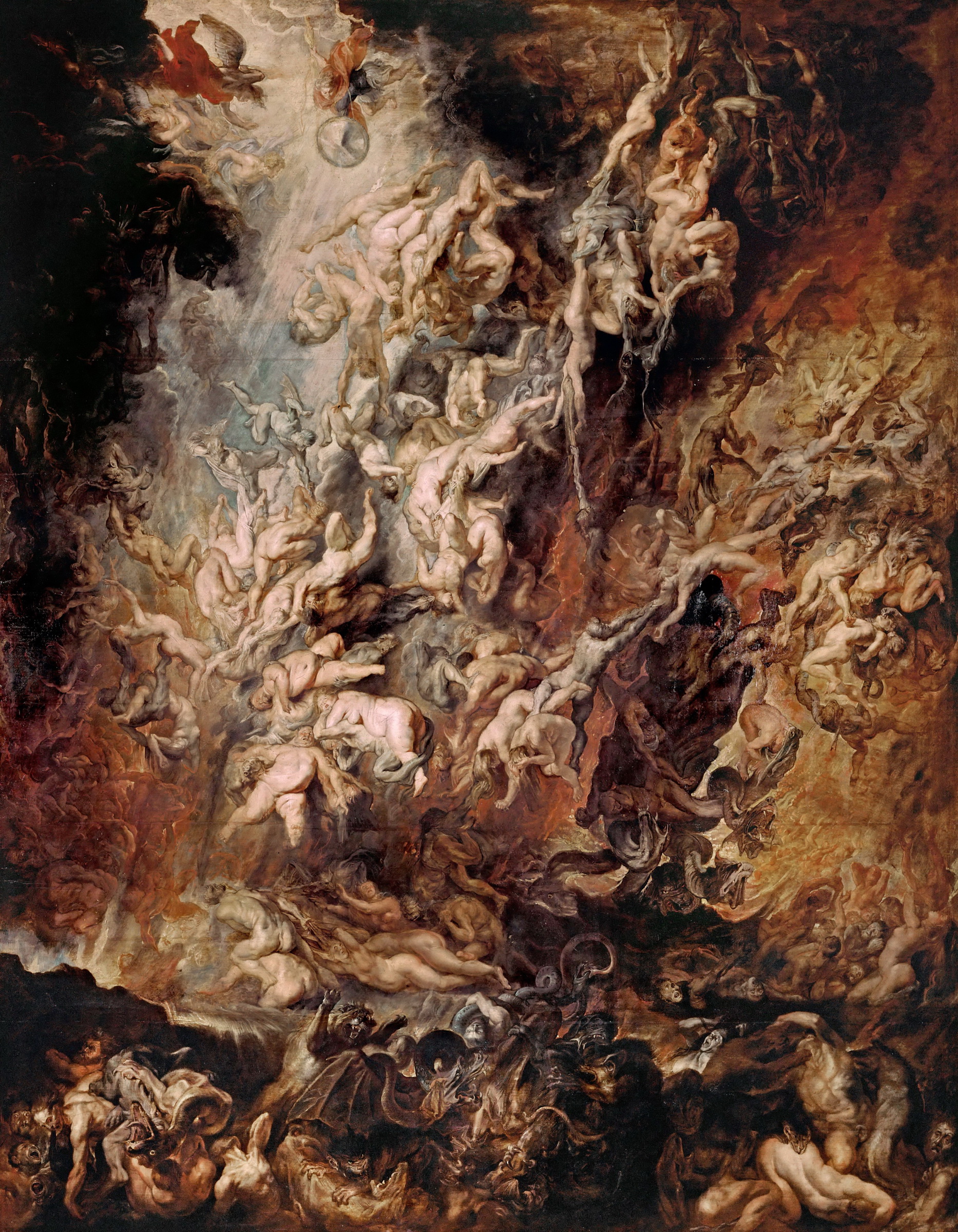
JLG: Langage is something that isn’t said, which can be shown a little and made heard. Technically, cinema can do that. Algorithms can’t, even though we’re getting there. To my mind, it’s this painting by Rubens, The Fall of the Damned.

Of course, I use langue to respond to technical problems. How to boil an egg? The first one who did that didn’t have words to say it. In my next film—which I don’t think I’ll be able to make, I’m too old and, moreover, there are things too difficult to pull off for me in the current state of cinema—there’s a sequence where I start from Nicéphore Niépce’s reflection. I asked Nicole the question so that she asks it to her students at the Fémis. What did Nicéphore Niépce think when he captured his first photo from the window? Can we imagine that today? Did he think: “What did I just do?” And what do we think, today, of what he did? What did he do in reality? He then took a lot of time, and Daguerre caught up with him, to fix this photo in place. And I call this sequence the “idée fixe”.
All of a sudden, I come back to Russia-Germany because it was my childhood and no one told me anything. So it interests me to understand the world we lived in then, even in Switzerland. That’s what the “idée fixe” became. And I’m trying to find other intersection points with the idea of being “fixed”: the military salute, the call to attention, etc.
What did Niépce think? I don’t have a precise answer. Filmmakers today think that when they push a button and film an apple tree or a strike, they have a piece of reality. There’s a festival not far from here, in Nyon, called “Visions du réel”. Niépce must’ve thought something. Because it was something. Photography is not cinema. When they filmed workers leaving the factory, the Lumière brothers were already thinking about something else altogether. Did they think they’d invented a machine where you pushed a button and you got reality? Afterwards, tons of texts were written. Is it reality? Is it the real? Fiction? Documentary? And we see that everything’s artificial. We nevertheless see the perversity of language. All wars since the 18th century have been declared beforehand. Because the text was all powerful. And they continue to announce, to make advertisements, if only to get elected.
JLG: But there’s a bit of langage in Hollywood, in this desire for catastrophe. When I spoke with people from the Resistance, what “struck” me—people are always struck (laughs)—was that they said that they couldn’t make films. They said they didn’t have money to make films. But they could make them in London. That was possible. The Americans did it, not the French. I tried to speak about it once with Stéphane Hessel, who often accompanied activists for Palestine. He was also the son of the couple that inspired Jules and Jim. I had my friend Elias Sanbar discuss it with him. And the question did not interest him. The Resistance happened through text, declarations, pamphlets and poetry. I didn’t know it, but a lot of texts were printed in Switzerland. Aragon’s poems were published by the La Baconnière publishing house in Neuchâtel. My French professor was ill and was replaced by a French prisoner who told us: “I don’t know what to tell you, but I’m going to make you read French texts that are being published on the sly as we speak.” In poetry, I stuck to José-Maria de Heredia, Leconte de Lisle, Théophile Gautier; Ronsard was unknown, François Villon was unknown, Rimbaud was unknown. He read Aragon’s Le Crève-Cœur and Paul Éluard’s Liberté to us, one in classic verse, the other in free verse. So that really “marked” me.
JLG: Yes, but they are two different tactics.
JLG: Poetry is written. Langage can’t really be written. It can be painted, sung, recited, manifested. The gilets jaunes are really a langage. That’s the reason most commentators get lost and wonder what langue is being spoken.
JLG: Because it can’t really be said. Commentators kill themselves with questions: “So you don’t have a leader? So you don’t know what you want?” They say: “What does it all mean?”
JLG: That’s what Péguy said: “We can say anything except what we do”, even when it’s about what you did during the day. Or you spend fifteen years trying.
JLG: Ah yes! Especially Anne-Marie’s, because she’s the owner. Or it’s the dog that’s Anne-Marie’s owner. We have a second dog after Roxy that we found in a shelter, a refugee from Spain. He’s very strange, he has a crooked shape. The two paws in the front are somewhat misaligned and, since he’s from Spain, I tell myself that he’s the reincarnation of a stretcher bearer from a battalion of the International Brigades. He came to our place and we set up our own refugee camp. His name is Loulou.
JLG: Not yet.

JLG: If I’ve often quoted it, it’s because I’d have liked to make a film on it, but it’s better that it remains a book. I gave this title to a chapter in Histoire(s). Literary signs of catastrophe were never considered premonitory signs of a catastrophe. It’s never been said: “We must do such and such thing so that there’s no war.” Today, we finally see that nature’s doing badly, and we’ve started to do something about it. But because it’s literary, I don’t believe in it so much, so are these films that show floods or melting glaciers. But that’s false text.
JLG: Yes, because there was a little bit of langage in it. It was a change from the usual articles by critics, even those I find interesting. It wasn’t the same old film images: a girl looking at a boy.


JLG: I hadn’t even noticed that she didn’t have a mouth. It was Anne-Marie and Jean-Paul who pointed it out to me. We see her again at the beginning of “Arabia” with the line: “The meaning of what we say comes less quickly than what we do.” Speech takes more time than action.
JLG: Exactly, it’s to link it with the beginning of the new sequence. We’re going to move on to something else. It’s going to take some time because thoughts travel slower than action.
JLG: “There must be a revolution.” We only hear the text. We don’t see the image. We see a donkey and a reel of unspooling film. If someone from the Middle Ages saw an image like that, he’d associate a revolution with a film reel, but also think: “But there’s also a donkey walking slowly.” I put all three and I believe in the three: x+3=1.
I now see a flat screen as a handicap, especially after the 3D of Goodbye to Language which was just a gimmick, a special effect, a tactic. One film that impressed me and Anne-Marie is Pialat’s Van Gogh. We sensed multiple spaces, owing both to the script about Van Gogh and to the fact that Pialat was a painter. Watching it again, there were really moments of 3D. I’ll show you; I saved these two shots (He shows us his iPhone). Van Gogh’s brother and doctor Gachet are approaching. The servant comes out and Dutronc is in front of her. There’s a sort of non-depth of field on the foreground and the focus is on the approaching characters. After he moves behind the servant, Van Gogh taps her on the buttocks and gets slapped. The feeling of 3D and space stems not from the fact that he taps her, but from the cannon fire of the slap. This cannon fire gives existence to the tap on the buttocks. The feeling of 3D comes from the sound.

Another shot, a bit earlier: two servants see Theo’s brother coming. There’s the bevy of guests at the corner. We get the abrupt impression that it’s filmed in 3D. That there’s 2D over there and 3D over here, even though it’s all in 2D. There are many such moments in the film. Anne-Marie and I had the feeling that the film was working on five or six levels simultaneously: now impressionism, now painting, now the Commune, now alcoholism, etc. Moreover, each of us had written a letter to Pialat.
JLG: It’s often in the relationships between shot scale, and changes to totally different kinds of shots. Films sometimes use the depth of field, but there really aren’t any scale differences. They’re there in Eisenstein, but it’s all so cut up and spliced that we don’t see them anymore. I had other photos (he continues to browse his iPhone).
This one’s from the Cahiers that came out today. I don’t buy it, but the newspaper seller gives them to me automatically. There are two photos of Jeanne. I asked Jean-Paul to send me a DVD. There’s a full-page photo of the young girl [1] and another photo taken from the film [2]. And I found that there was a great difference in the gaze. I’m talking only about the photo, which can sometimes express what cinema cannot. In the first photo, she’s staring at something we don’t know. It doesn’t matter where she is. But I don’t know if it’s a shot from the film.
JLG: But a shot as a photo is not a shot from the film anymore. On the other hand, the second image, as a photo, is a shot from the film. Here she’s staring where she’s been told to stare. I see a difference in gaze. In the first, they must’ve told her, “stare into space”. We must speak of the difference between a photo from the film and a photo that can remain a photo. If we can’t speak about it in a critique of Dumont’s film, we can’t speak at all. Especially since I think the film is made of long and static shots. The first photo is not yet this American actress, Rose Hobart, but it’s getting there. An actress, Léa Seydoux for example, can do the second photo. She can’t do the first. The little girl in Jeanne can because she is ten years old. But it’s an actress in the second photo.
JLG: It’s a frozen moment in cinema, which hence becomes a photogram, hence an archive. And I show some of them. In the film, there’s a shot of Marilyn by Avedon. She is seen in profile, thoughtful, black and white, very pretty. It’s a shot from a sequence that he had snapped away in bursts. I work quite a lot with such comparisons. On first sight, because after that, on a second or third look, it’s no longer the same thing. A photo is always at first sight. Cinema retained some of that. That’s the reason we, too, shoot many takes. We think that the tenth take will necessarily be better. Or like Bresson, the sixtieth. Or like Chaplin in City Lights: in the six-hundredth take, he could capture the blind girl’s glance. I want to shoot a sequence called “Fake News”. I don’t know if I’ll be able to. I don’t even know if I’ll try. I’m thinking of picking certain people from a news program, and shooting a reportage at their homes, in their private lives, where this person is different, not like on television. I don’t think anyone will agree to it. It might’ve perhaps been possible just after Contempt, but not today. And I can’t use an actor to play the role. Because that would make the actor play two times. My famous theorem x+3=1 where you must eliminate two. (He continues to browse...)

JLG: I’ll work like an archaeologist who visits certain regions and not others. And who collects certain things like my granduncle, Théodore Monod, who collected stones and branches from the desert. In Prisoner of Love, Jean Genet said that you have to go to the desert to find images.
JLG: There is another reference elsewhere to the White Rose, Hans and Sophie Scholl’s group, the German resistance fighters executed in 1943.
JLG: It was a text by Borges. After crossing paradise, he gets a rose as proof.
CDC: “If a man crossed Paradise in a dream, let him receive a flower as proof of his passage. And upon his awakening, he found this flower in his hands, what can I say then? I was this man.” In The Image Book, I had the same feeling at the very end, with ardent hope on the dark screen. It’s as though you placed something in our hands.
JLG: Since a lot of it was about war, I didn’t want people to tell me: “It’s a little sad.” Using this text by Peter Weiss who only narrates misfortunes and failures... What I really like is that he’s a defeatist.
JLG: It’s you who think that. I don’t think so. There’s a line by an author I’ve quoted a lot, Denis de Rougemont: “It’s in hope that we’re alive.” Which makes me laugh because he adds: “But this hope is true.”
JLG: We’re still in pleasure.
JLG: Yes, we have hope.
JLG: In Maupassant’s short story, the man is brought home and his wife removes his mask. You see a man who still wants to enjoy life.
JLG: Yes, dialectics. In Film Socialism, there’s a nice text by Sartre which says that dialectics is at once everything and its opposite, nothing and its opposite. At the beginning of Goodbye to Language, there is another text by Sartre on the definition of philosophy: “Philosophy is a being, the heart of it being the question of its being, insofar as this being posits a being other than itself.” There’s leftism and classicism at the same time! I’m one of the few who thinks that Sartre’s best texts are on painting. In a text on Lapoujade, a painter from the 1950s-60s, he writes: “Alas, the indignation doesn’t go all the way to the tip of his brush.” It corresponds to the bad opinion I’ve had for a long time of so-called activist films (films dits militants). For the most part, their indignation doesn’t go all the way to the tip of their brush.

JLG: He tried to teach me to paint. I liked it but I found his painting very systematic. We made a film about flowing blood. I tend to constantly forget what I was about to say… With age, most words vanish and slip away. They were used so much. Then they come back gently at a later point. The situation is aggravated by the fact that I don’t believe in them very much…
JLG: Yes, it’s not worse. I don’t worry about it. If I can’t find the words, I can nod off without trying to recall them. If they want to come back, they will. I reread Michelet’s The History of the French Revolution. The arrest of Fabre d'Églantine. It was he who made the revolutionary calendar. He was a poet and a playwright. I couldn’t even remember the first words of “Il pleut, il pleut, bergère” (It’s raining, it’s raining, shepherdess). And then it came back…
JLG: I really liked this interview with Rivette. They change the laws so that they’re always there. I don’t see it the same way he does, at least for films.
JLG: Yes, but I really like the law, in tennis.
JLG: We agree on the rules of the game.
JLG: I’m always for the referee. But I’m wary of the video screen. I’m not entirely sure that they show the referee the correct shot when he goes out to verify. After they’ve shown something, they tell something. Then there’s a second interpretation. I prefer the simple law in which the referee makes a mistake, everybody screams etc. If a goal is accepted or refused, you only have to score another.
What I really like about football is that it takes me back to my adolescence. I think of the memories of my adolescence, or a little later, and say, “It was better then”. I’m interested in what’s happening now, all the while retaining this “it was better then” as a dialectical agent. It’s very bad now/it was better then/but perhaps it’s not so bad now.
JLG: It’s swimming towards the unknown. It’s mixing up everything it can. It says things even though it doesn’t know it’s saying things. There are people who see things, but unfortunately, they only write books or make films. Me or Straub, we aren’t made to revolutionize the world. We are made to look at certain things and that’s all. In my view, Straub is a holdover from sculpture in his intransigence, which we end up accepting. His films aren’t flat because we see that he’s constantly digging. Like how Michelangelo tackled marble, even if it’s too grand an example. His film on Cézanne or on Montaigne, or his last film (Gens du lac, ed.), on a smuggler from Vaud who smuggled refugees or resistance fighters between Thonon and Lausanne, are more than respectable, even very beautiful at times.
I find that France and the Latin countries handle things better than the Nordic countries (mi-nordiques5 ). Nordic countries have mastered socialism in their own way, capitalism in their own way. France has convulsions. In Peter Weiss’ book, there’s a very good analysis of Delacroix’s painting Liberty Leading the People. He doesn’t focus on the woman with the flag, but on a gentleman with a top hat, a bourgeois. This character makes me think of Enjolras, the hero of the barricades in Les Misérables, and in fact not really, for Enjolras is a true-blue militant, like Romain Goupil, if you see what I mean. The Goupil I knew when he came out of high school in ’68 and who founded the high schoolers’ Vietnam committee. Today, he’s on BFM or LCI. In his book, Peter Weiss, who is a German survivor of the International Brigades, arrives in Paris and the first thing he does is to go to the Louvre. He sees this character in bourgeois clothes, who has a gun but doesn’t shoot. According to Weiss, he hesitates to shoot. He’s out to get involved in the demonstrations. He sympathizes, but he’s also afraid. He’s like Frédéric Moreau in Sentimental Education, who witnesses the National Guard’s attack in 1848. There he recognizes an old friend. Flaubert’s sentence is magnificent: “And Frederick, his jaw wide open, recognized Sénécal.” The Sénécal who was once a leftist. And the following sentence, a magnificent montage: “He travelled.”
And that inspired me, after the first section, to leave for the Far East (sic) with happy Arabia.
JLG: Yes, I read some reviews that said, “the amazing sequence of trains”. They’re talking about the trains, not about what’s happening there.
JLG: I hate it, but people love it. These are fetishist collections. The surrealists at least spoke of collage.
CDC: Whereas there’s no relationship (rapport) in those art pieces.
JLG: I’ve never seen a government that orders reports (rapport) on film. It could ask for one from a filmmaker. If it were Ruffin, he’d do it. They could’ve asked Chris Marker at that time. He was fantastic with reports. I’m more into philosophy or the science of reports. He was into reports. In schools, there’s a small instrument called a protractor (rapporteur). And they used to call me the “nasty protractor” because I reported little denunciations. In its perversity, the French language has something that makes it more interesting than others.
JLG: There are more associations. And in these associations, we can find more “distant and just” things like Reverdy called for. I recently saw two old films on DVD that seemed to predict the situation I’m in now: Nouvelle Vague and Made in USA. I didn’t like Made in USA so much, given the way I made it. It was a quickie to make Beauregard happy, made at the same time as Two or Three Things I Know About Her. It was a hustle. I extended the sequences to get an hour and a half. Today, I see it as a painting film, just colors one after another, with a script that was anarcho-leftist-militant, I don’t know what… In Nouvelle Vague, in contrast, there’s just text. I asked the assistant, Hervé Duhamel, to collect interesting or “striking” lines, as they say. And that’s all there is.
JLG: Yes, there’s the reverse shot. But it’s mostly only text.
JLG: Yes, but it’s the critic who looks at an artist’s evolution. I don’t think about it at the time of shooting.
JLG: After the impressionists, of course. Epstein and Flaherty too.
JLG: Jean-Pierre Gos, whom I’d seen perform at the Vidy theatre. He had worked in a little film I’d made, Liberty and Homeland. I preferred using an actor, but I read it too. There’s a connecting passage between him and me. The transition from his voice to mine bothers me a little. Like all commentators, his voice rises when he tells a truth. I like voices that drop, like a period. Actors don’t know how to do periods well. And semi-colons, not at all. They can’t distinguish between a colon, a semi-colon, a period, a comma. There should be four different intonations. That’s what certain old actors like Cuny knew.
JLG: I didn’t do it deliberately. I recorded it only twice, because I utter almost the same text and because it’s repeated at one point. Just a while earlier, there’s a text by Marx and Engels on Eugène Sue where we understand absolutely nothing (laughter).
JLG: You should see it in the installation, where we hear what’s being said on the left. And then, listen to what’s being said on the right. We notice it and we compare: “Ah yes, it’s not the same text.” It happens again at another point, over a speech by Robespierre at the Convention, taken from a film by Stellio Lorenzi. Television wasn’t bad at that time.
JLG: In my view, these are the three from the Nouvelle Vague. It’s missing Rozier, who wasn’t at Cahiers, but who was the Nouvelle Vague all alone. Chabrol isn’t part of it.

CDC: Even the first films up to Les Bonnes Femmes?
JLG: I thought so at that time. But he was more concerned with selling films. I couldn’t not put Truffaut in there. Chabrol is a pharmacist even if he wrote a Hitchcock. But he made an incredible number of films. I tried to find The Blood of Others based on a novel by Simone de Beauvoir. I didn’t know it at all.
JLG: He was nice. I liked him a lot, not his films. I can find them nice because he’s the one that made them. There’s one that I liked a lot, but he didn’t. La machine à découdre.
JLG: Yes, it’s my life.
JLG: I debuted in the second Revue de cinéma when it was with Gallimard and it was with the help of Doniol-Valcroze that I entered Cahiers little by little. Doniol-Valcroze was the son of a friend of my mother’s at the Victor-Duruy high school. I thought he received me because of that. I learnt later that he was demobilized and took refuge in Switzerland. It was my mother who got him to France, to Thonon, on a little speedboat called “the hyphen” and with which we often went vacationing in my grandfather’s property. I discovered that after Doniol-Valcroze’s death. I wasn’t against the Cahiers management at that time. He was the editor-in-chief along with Bazin. He was a “gentle man” in the literal sense of the term. I didn’t know Bazin like Truffaut did at all. I knew Bazin as the head of a communist organization, Work and Culture, just opposite the Beaux-Arts. There was a small library opposite run by a friend of Rivette’s from Rouen. It’s a story that I attached myself to little by little, not from the beginning, but there are all these stories I want to keep to myself. I was prudent like the Delacroix character. I stole some money from one of my uncles to finance Rivette’s first short film, Le Quadrille.
JLG: Rivette. Then Truffaut, but before he made Les Mistons. I don’t know if he was already married to Madeleine Morgenstern, whom I liked a lot. He’d become rich by this point. Madeleine Morgenstern’s father was the head of a distribution company called Cocinor in the Nord region and in Paris. But when he wrote “A Certain Tendency of French Cinema”, I hung out with him a lot. I wasn’t so much with Rivette. We could go see films at 2pm and leave at midnight because it was a single-admission cinema. I’d give up after an hour or two. Rivette stayed until the end. Rohmer had a different life. He was a professor and lived in a small hotel opposite the Sorbonne. His name was Schérer and he started signing “Rohmer” so that his mother didn’t know he led a dissolute life in cinema. These were three different friends. It was real camaraderie with Schérer—I still call him Schérer—Rivette and Truffaut. Schérer was one of the few who knew which woman I was in love with, and I was the only one to know that he was in love with the wife of an old head—a communist—of the CNC. Rohmer was ten years older and he was the counterbalance to Bazin and Pierre Kast. In The Image Book, I have a shot of the Liberation of Paris. We see an FFI member from behind, with a gun on his back, speaking to a woman on her knees. To my mind, this man was always Pierre Kast. I hope it’s true.
JLG: Very little. It was the cinema. Even girls were a secret. I remember a moment during the Algeria war. I was at the Place de l'Alma with Rivette. A car sped by with the “nee-naw” of the OAS siren. I saw that as a shot by Douglas Sirk. And Rivette chided me. I couldn’t see things politically at that time. The one who could easily do that was Straub, because he was there from the beginning.


JLG: It’s become very strong, disgusting. That said, I remain in cinema. I am Swiss. I couldn’t vote in France, so I arrived there as a foreigner. A Swiss brigade in France… But what you say is true everywhere. It’s stronger in Russia than in France. I’ve always had a phobia of the police and military service. I’m not against bombs, but I’m antimilitarist. And people forget that, in The Image Book, when I say “I’m on the side of bombs”, a man caresses an antelope in the image. People don’t make associations between image and text anymore; they don’t see when an image is contradicted by the text. They don’t know if the image takes precedence over the text, or vice versa.
JLG: It takes two or three times to examine it. While editing it, I didn’t see the antelope’s fear as you do. It trembles, but like a dog trembles when one caresses it. We take our dog, the old Spanish stretcher-bearer, to a club thrice a week. We don’t know why, but he starts barking at the moon. We don’t know if it’s fear because it makes him think of his past, because it’s a street dog. We don’t know if it’s joy, because he likes the place a lot. And it’s very loud. He has to bark at the moon like in a Jack London novel.
I recently saw Rozier’s short film, Rentrée des classes. It’s almost the first ecological film, much before everyone else. It’s a film on civil disobedience, like in Thoreau. I am for disobedience, but I remain in cinema. I once believed I could get involved in worldly affairs. When Anne-Marie scolds me, she tells me: “Go and make your revolution, but then no coffee today!” (laughs).
JLG: We see how difficult it was for Charlie Hebdo to find other cartoonists. I still find Willem extraordinary. If we weren’t in so dark a misery, it would be better to say: “It’s a sad and beautiful time.”
JLG: Capitalism extols the individual whom it tries to stupefy with advertising, but who still remains an individual. Yes, it’s sad. One must have a lot of philosophy, or be very enthusiastic like Edgar Morin, to find everything marvelous (laughs). There’s something harmful about it, and it’s that they always find it necessary to invent things. All they have to do is to stop.
I’m currently reading a mathematics book that I don’t understand well, on Georg Cantor. He isolated himself and went a little crazy. He started to think about infinity in mathematics. That raises many questions and it becomes text. I quite like following the history of mathematics, without understanding it. Russell asks the question: “Is the infinity of everything bigger than the infinity of the part?” To my mind, it makes no sense because it’s just text. It’s better to look at a Monet painting.
I had a project on the story of Niels Henrik Abel, a Norwegian mathematician from the 19th century. He believed he had discovered a solution to fifth degree equations. Being the non-literal type6, I thought there was something to understand here. He came to Paris to submit his theorem to Cauchy, the mathematician at the Academy of Sciences, who deemed that it wasn’t interesting enough. He came from Norway on foot and he returned on foot. He ended up demonstrating that there’s no solution to a fifth-degree equation. Since then, there’s been an Abel prize, like the Fields medal. I thought of a film on this journey. On his onward journey, he’s busy demonstrating what he wants to expound in Paris, and on his return trip, he starts to demonstrate the opposite.
At the time when we were fighting for things, we told ourselves: “Not a word anymore without denouncing the Vietnam war.” We weren’t yet going all the way to the tip of our brush, but we were trying. We had brushes and colors. I’d proposed a film to the North Vietnamese. We start with the bombing. We start with a class that’s reading Bérénice. We follow the class hiding underground and continuing the lesson: “In a month, a year, how we must suffer too”… That’s where it wasn’t good, it was too tactical, too precise. But this passage from Racine is in Scénario, my next film. I see how it’s making sense little by little, how the rivulet goes before the river, how the pathway goes.

8 ”Tant de mers” (so many seas) in the original replaced with “Tant d’amer” (so much bitterness)
CDC: What happened?
JLG: I’m losing my way a little… I’m in this no man's land. I’m lost. What I’ve always done, and consciously so, is to remain in cinema, despite the activism, the signatures, the social movements, despite being for the gilets jaunes, whoever they are, the emergency doctors, whoever they are. But to confine myself to cinema and so its history too, which allows one to welcome the grand history. Cinema is the little history, but it’s grand as well.
And so it happened like that from For Ever Mozart onwards, my last classical film, which doesn’t prevent me from making small films on the side from time to time, like snipers in war, or spies. I took a lot of time, with In Praise of Love, to become aware of what I could do. And something that was still unconscious divided the film into two or three sections. I even coined a very simplistic equation, which I call the axiom of montage, like Euclid had coined his five axioms: x+3=1. To get one, you must eliminate two. It’s not really an equation. When I showed it to Badiou, he didn’t really know what to do with it. There was a foretaste for divided films, like One + One. This unconscious element became more conscious from In Praise of Love onwards. After this, it was sometimes divided into three, into two.
Today, what’s all wrong for me is that the screen is flat. I watch BFM and LCI, I prefer LCI because of their talking-heads (à cause de la tête des gens). From time to time, I watch Serge July, whom I once knew. I follow sports too. What’s wrong with these news channels is that, whether they’re speaking of the gilets jaunes or the metro strikes, they’re mirroring the situation.


Anne-Marie and I are French refugees in Switzerland who have agreed to obey Swiss laws. We watch French television and we read three French newspapers: Libération, Le Canard Enchaîné and Charlie Hebdo. Other than that, nothing. I’ve never read Swiss newspapers. We don’t know what’s in there. We live as refugees here, having accepted the local passport, certain local laws. It’s important because France seems to me to be one of the only countries in the world that’s still interesting, given its difficulties, its internal problems, its resentments, its laws, but at the same time it’s not able to get by. It seems to me that it’s there that we can find some explanations, provided we work with what cinema should be. So it’s impossible. We must cure a disease with medicines we’ve not yet invented or that we don’t want to invent.
Did you see today’s Libération? Their ad for the foldable Samsung phone? What I find interesting is that this ad revolves around books. I’ve underlined the words on the last page: “opens like a book”, “bedside book”, “brochure”, “back cover”, “deluxe edition”, “ease of reading”. Even those who are in the image—to my mind, it’s an image that’s already text—confess openly. It’s really up my alley: everything becomes text. The telephone is a mini-book. The text is more powerful than ever. In advertising, one always needs words. Remove the words and you’ll see an inability to show image and speech.
And they are flat. And it’s not possible anymore to “put your foot in your mouth3.” Céline said that the most difficult thing is to put flatness into depth. When there’s no depth, one puts flatness over flatness. And that’s upsetting. Said in words like I’m doing now, it has no impact as I believed it did fifty years ago.

So that’s where I am now. I’m lost because I think I’m alone. I’ve never seen a great writer say: “Langue is not langage”. The only one I’ve read who says that is Robert Redeker, whom I knew once and who was a friend of Lanzmann’s. He writes: “Langue is not langage”, all the while expressing himself in langue. But it can’t be said. It’s for that reason that the only ones who tell me something are painters. There are musicians too, but I’m not so familiar with them, because I only use them tactically, not strategically. It’s the other way around with painting, until the impressionists and a little thereafter.
CDC: You speak of langage as an act. In The Image Book, the action on the image is very visible.
JLG: Yes, but it’s just a detail. It’s my taste for expressionist and fauvist painting. It’s my sister Rachel, who became an art professor, who explained Picasso to me. “There’s light and shadow on this face, and the shadow is totally masked, which makes it two faces, so to speak.” She saw something I didn’t. Painting was always very present because it’s not flat. There’s a very interesting film from the silent era, Lubitsch’s Lady Windermere's Fan. Preminger remade it. Lubitsch’s film is space. Schérer, Rohmer, wrote an article, “Cinema, the Art of Space”, whereas we were quite in the cinema, an art of time. When we compare the two, Preminger’s film is just dialogue and text, a story. If we eliminate the dialogue, we don’t know what’s happening. With Lubitsch, we understood everything. It got lost with the emergence of dialogue and the whole power of language, like this Samsung ad. There’s another film like that where the understanding comes from the actors’ performance, especially the girl’s, it’s the film with Rose Hobart.
CDC: Frank Borzage’s Liliom?
JLG: That’s the one. In my view, no actress could perform a scene on screen while expressing something all the time. She didn’t have a great career because she couldn’t perform in just any kind of film. If we compare Borzage’s Liliom with Fritz Lang’s Liliom, Fritz Lang is out (English in the original –AR.)! She has something. I can’t say. If I were still a critic, I’d look for words… “Innocence” isn’t enough. It can’t be said and it isn’t said: it can be seen.
CDC: A recent book by Jean Paul Civeyrac (Rose pourquoi) speaks about the mystery of her performance in the film.
JLG: Yes, I read it. She is unique. We can find that among certain actresses. Adèle Haenel has something but the films don’t measure up.
 |
"Just... two eyes."
|
CDC: Given that you are wary of language today, do you draw inspiration more from silent cinema or early talkies?
JLG: No, not particularly. In Langlois’s time, we were trained to consider the Borzage film at the same time as a film by Garrel, Verneuil or Gilles Grangier. We were only three or four. Rivette, Rohmer, Truffaut and I.
CDC: In The Image Book, there’s also the pivotal couple from Dovzhenko’s Earth, in a drawn-out shot-reverse shot, and the image is magnificent, very carved-in. How important to you are this couple and the text “If we were alive/But we are alive!” that’s superimposed on the silent images?
JLG: It’s a text by Blanchot. I read his first book when I was very young, about 15-16, as I read other books that tried to go further, Nadja or Aragon’s Le Paysan de Paris. I tried to shoot a sequence with this text for Our Music, but it fell flat and we removed it. We had to make a fake-real 3D with the sound next to the image, and not in the image. It was in line with the real question of the “La région centrale” sequence. Bernard Eisenschitz asked me, “What’s la region centrale?” I told him, “Love, of course.” But few see it that way. They prefer talking about Michael Snow’s film.
CDC: When we hear, over the woman’s face: “But we are alive!”, it’s a jolt, as though we were finally leaving a dark forest.
JLG: For me, the second section, “Happy Arabia”, was a return to reality, I agreed to make a film that was a little flatter. You could say that the first section is more documentary, that the second section is completely fictional, made with actors I picked from films and who come from a novel. I saw the film twice more. The first time, I thought, “Ah, it’s too different. That’s too bad.” Now, I tell myself that it had to be bad. One is more flat. The sound is much more varied too. Television sound can’t make a distinction, like an orchestra that’s constantly asked to play different things at the same volume. The poor conductor is overwhelmed.
CDC: Are you saying that a flat moment is useful, so that it can take off again?
JLG: When the Russians lost to the German army, they went back on the offensive.One clearly sees the difference. The Germans were strong in simple tactics, but had little strategy, except Hitler’s, which was that of Alfred Jarry. On the other hand, the Russians could resume with a strategy different from the one they had, and which was practical too.
CDC: So the last section is Russian? (laughs)
JLG: Yes, I’ll always be for the Russians. In Goodbye to Language, one of the young girls says: “If the Russians become part of Europe, they won’t be Russians anymore.”
CDC: Did you know that the film’s ending would head towards this “ardent hope”?
JLG: No, I shot several endings. I prolonged it bit by bit because I wanted people to recall that they saw something other than Arabia. The final text comes from Peter Weiss’ The Aesthetics of Resistance.
CDC: Had you read it already?
JLG: No, but I knew him because he wrote the play Marat-Sade. I read the first three volumes of The Aesthetics of Resistance, 1,000 pages, for the film. It’s his story, from the Spanish War to the end, when he was a refugee in Sweden and used to meet Brecht, who was there too. I work a lot in parallel. News programs mention “in parallel” when they speak of perpendicular (laughs).
CDC: It’s rather the counterpoint with you… You distinguish counterpoint from harmony.
Yes, it’s counterpoint and melody. The two go together. I sent a riddle to Nicole about that. Like a sphinx who sends riddles to his three Oedipuses, or to his three Antigones (Nicole Brenez, Jean-Paul Battaggia, Fabrice Aragno, ed.), I give them a small problem. Nicole replied with another quotation, which made me think… Anaxagoras Chaumette, one of the leaders of the Paris Commune during the Revolution, along with Hébert, founded the music conservatory in 1793 in the middle of the Terror. That’s quite extraordinary. Two centuries later, it inspired me to make a scene in Germany Year 90 Nine Zero. While visiting the old Babelsberg studios that had started crumbling, Eddie Constantine asks the count Zelten: “Will there be music when darkness takes over?” I gave Zelten a line from Brecht: “Yes, there will be the music of darkness.” I asked Nicole, without telling her all this: “Is there a link between this and that?” She couldn’t reply, because it was personal. But those are the links and associations I make. Associations and separations.
CDC: Juxtaposing “distant and just” realities, as Reverdy says. You weave multiple threads at the same time.
JLG: Yes, Persian carpets are very much like that. There are many swastikas in Persian carpets.
 |
| Le Studio d'Orphée |
JLG: I didn’t know that at all. I came across him in an article. All that is incredible. And then, he was the French ambassador to St. Petersburg. I took it as an opportunity to speak about the war.

CDC: He even speaks about immolation. It’s a moment of despair, but also of irresponsibility, because humanity is overwhelmed by universal laws.
JLG: The Second World War is still widely studied from other points of view. I’m reading a hefty book at the moment, Barbossa, 1941, the Absolute War (by Jean Lopez and Lasha Otkhmezuri, ed.) on Germany’s attack on Russia. It’s just an opposition of texts, from soldiers’ diaries as well as official speeches: it’s just text against text. Every time Stalin utters a word, there are 10,000 deaths. Same with Hitler. I’m not speaking of horses, because the cavalry was still there. That’s why I show a falling horse from time to time.
CDC: It’s interesting that you mention horses. You spoke about the evolution of your cinema. There are more and more animals in your films: your dog Roxy in Goodbye to Language, the parrots, the cats and the llama in Film Socialism…
JLG: Yes, it came little by little. I once had a dog that I really loved. Roxy reminded me of it. I gifted a dog to Anne Wiazemsky. There has always been something. At the moment, it’s animals. I’m all for the L214 association, without getting personally involved.
CDC: The animal gaze seems to have become important for you. In Film Socialism, you frame the llama’s head with its large black eyes.
JLG: Between a dog and an actor, there’s no comparison. According to legend, God offered monkeys the power of speech. They said, “Certainly not.” We understand them. Their gestures still remain. Dogs are at the same time lost, kind, open, except when they are ready for war. I picked up the llama in Film Socialism after spotting it in a field ten kilometers from here. And donkeys, of course. I have a great admiration for Au hazard Balthazar, even if it’s not Bresson’s best, which is A Man Escaped.
CDC: Why do you prefer that?
JLG: Because it’s faithful to its title in every shot. It’s a film that begins with hands. I realized that I had support and that I did well to begin with hands! It’s the hands that look to escape. And the camera looks to escape in every shot. It never goes elsewhere. The Trial of Joan of Arc is also a little like that, but it has more to do with the assertion of oneself, staying put like this (he folds his hands). The other one deals with escape.
Charlie Hebdo published Cavanna’s old texts. In one of them, he spoke of horses that had disappeared from the streets, and he spoke of their eye. It’s also true of birds. It’s most obvious with dogs, who have a human look that humans don’t have. And there’s no equal.
CDC: There’s a magnificent line in Goodbye to Language: “A dog is the only being that loves you more than it loves itself.”
JLG: It’s from Rilke. There must be great writers who look to go elsewhere… I went elsewhere by following Roxy.
CDC: If language is a watchword, which provokes thousands of deaths with one word, is the task of The Image Book to make us listen differently?
JLG: Or to forget it. Or to make one think that, within the image, a certain Word/speech is expressed which Heidegger was only able to pursue but never further, and which is sometimes attained by poetry. Rimbaud, for example.
CDC: In the end, Anne-Marie Miéville says that we aren’t attentive enough. Attentive to the world?
JLG: It’s not necessarily attentive to the world, in the way one would simply make a film that’s attentive to poor people who live in such and such places.
CDC: Attentive to animals, to nature…
JLG: Yes, or something else altogether. The sociologist-philosopher Elias Canetti, who was well-known for his book on crowds, said that we are never sad enough for the world to be better. Later he spoke of the earth “submerged in letters of the alphabet.” He gave me support in his own way. When we say langue, I mean the letters of the alphabet, which Plato was against.

CDC: And langage?
JLG: Langage is something that isn’t said, which can be shown a little and made heard. Technically, cinema can do that. Algorithms can’t, even though we’re getting there. To my mind, it’s this painting by Rubens, The Fall of the Damned.
Of course, I use langue to respond to technical problems. How to boil an egg? The first one who did that didn’t have words to say it. In my next film—which I don’t think I’ll be able to make, I’m too old and, moreover, there are things too difficult to pull off for me in the current state of cinema—there’s a sequence where I start from Nicéphore Niépce’s reflection. I asked Nicole the question so that she asks it to her students at the Fémis. What did Nicéphore Niépce think when he captured his first photo from the window? Can we imagine that today? Did he think: “What did I just do?” And what do we think, today, of what he did? What did he do in reality? He then took a lot of time, and Daguerre caught up with him, to fix this photo in place. And I call this sequence the “idée fixe”.
All of a sudden, I come back to Russia-Germany because it was my childhood and no one told me anything. So it interests me to understand the world we lived in then, even in Switzerland. That’s what the “idée fixe” became. And I’m trying to find other intersection points with the idea of being “fixed”: the military salute, the call to attention, etc.
What did Niépce think? I don’t have a precise answer. Filmmakers today think that when they push a button and film an apple tree or a strike, they have a piece of reality. There’s a festival not far from here, in Nyon, called “Visions du réel”. Niépce must’ve thought something. Because it was something. Photography is not cinema. When they filmed workers leaving the factory, the Lumière brothers were already thinking about something else altogether. Did they think they’d invented a machine where you pushed a button and you got reality? Afterwards, tons of texts were written. Is it reality? Is it the real? Fiction? Documentary? And we see that everything’s artificial. We nevertheless see the perversity of language. All wars since the 18th century have been declared beforehand. Because the text was all powerful. And they continue to announce, to make advertisements, if only to get elected.
CDC: They announce catastrophes all the time these days. There’s a sort of desire for apocalypse.
JLG: But there’s a bit of langage in Hollywood, in this desire for catastrophe. When I spoke with people from the Resistance, what “struck” me—people are always struck (laughs)—was that they said that they couldn’t make films. They said they didn’t have money to make films. But they could make them in London. That was possible. The Americans did it, not the French. I tried to speak about it once with Stéphane Hessel, who often accompanied activists for Palestine. He was also the son of the couple that inspired Jules and Jim. I had my friend Elias Sanbar discuss it with him. And the question did not interest him. The Resistance happened through text, declarations, pamphlets and poetry. I didn’t know it, but a lot of texts were printed in Switzerland. Aragon’s poems were published by the La Baconnière publishing house in Neuchâtel. My French professor was ill and was replaced by a French prisoner who told us: “I don’t know what to tell you, but I’m going to make you read French texts that are being published on the sly as we speak.” In poetry, I stuck to José-Maria de Heredia, Leconte de Lisle, Théophile Gautier; Ronsard was unknown, François Villon was unknown, Rimbaud was unknown. He read Aragon’s Le Crève-Cœur and Paul Éluard’s Liberté to us, one in classic verse, the other in free verse. So that really “marked” me.
CDC: Are langage and poetry the same thing?
JLG: Yes, but they are two different tactics.
CDC: What would be the tactic of langage with respect to that of poetry?
JLG: Poetry is written. Langage can’t really be written. It can be painted, sung, recited, manifested. The gilets jaunes are really a langage. That’s the reason most commentators get lost and wonder what langue is being spoken.
CDC: Why are the gilets jaunes langage?
JLG: Because it can’t really be said. Commentators kill themselves with questions: “So you don’t have a leader? So you don’t know what you want?” They say: “What does it all mean?”
CDC: So langage is something that isn’t said?
JLG: That’s what Péguy said: “We can say anything except what we do”, even when it’s about what you did during the day. Or you spend fifteen years trying.
CDC: Is your relation to your dog langage?
JLG: Ah yes! Especially Anne-Marie’s, because she’s the owner. Or it’s the dog that’s Anne-Marie’s owner. We have a second dog after Roxy that we found in a shelter, a refugee from Spain. He’s very strange, he has a crooked shape. The two paws in the front are somewhat misaligned and, since he’s from Spain, I tell myself that he’s the reincarnation of a stretcher bearer from a battalion of the International Brigades. He came to our place and we set up our own refugee camp. His name is Loulou.
CDC: That’s the next film? Perhaps a small film on him?
JLG: Not yet.
CDC: Is there langage in nature? You often quote Ramuz’s The Signs Among Us. One also thinks of Baudelaire’s Correspondences. Is the world a sign language (langage des signes)?
JLG: If I’ve often quoted it, it’s because I’d have liked to make a film on it, but it’s better that it remains a book. I gave this title to a chapter in Histoire(s). Literary signs of catastrophe were never considered premonitory signs of a catastrophe. It’s never been said: “We must do such and such thing so that there’s no war.” Today, we finally see that nature’s doing badly, and we’ve started to do something about it. But because it’s literary, I don’t believe in it so much, so are these films that show floods or melting glaciers. But that’s false text.
CDC: You’ve said that our “Herbarium” issue in April, dedicated to trees and flowers, was interesting.
JLG: Yes, because there was a little bit of langage in it. It was a change from the usual articles by critics, even those I find interesting. It wasn’t the same old film images: a girl looking at a boy.
 |
| Cahiers du cinéma , Avril 2019, no. 754 available here Photos AR |
CDC: Where does this recurring figure of Bécassine in The Image Book come from?
JLG: The epigraph is a line by Bernanos. I show her just as she is known in France. She is silent.
CDC: Was it the gesture that interested you?
JLG: I hadn’t even noticed that she didn’t have a mouth. It was Anne-Marie and Jean-Paul who pointed it out to me. We see her again at the beginning of “Arabia” with the line: “The meaning of what we say comes less quickly than what we do.” Speech takes more time than action.
CDC: It’s just before the key from Notorious.
JLG: Exactly, it’s to link it with the beginning of the new sequence. We’re going to move on to something else. It’s going to take some time because thoughts travel slower than action.
CDC: The Image Book overflows with very affirmative political lines: “I’ll always be on the side of bombs”, “There must be a revolution” …
JLG: “There must be a revolution.” We only hear the text. We don’t see the image. We see a donkey and a reel of unspooling film. If someone from the Middle Ages saw an image like that, he’d associate a revolution with a film reel, but also think: “But there’s also a donkey walking slowly.” I put all three and I believe in the three: x+3=1.
 |
| Histoire(s) du cinéma |
I now see a flat screen as a handicap, especially after the 3D of Goodbye to Language which was just a gimmick, a special effect, a tactic. One film that impressed me and Anne-Marie is Pialat’s Van Gogh. We sensed multiple spaces, owing both to the script about Van Gogh and to the fact that Pialat was a painter. Watching it again, there were really moments of 3D. I’ll show you; I saved these two shots (He shows us his iPhone). Van Gogh’s brother and doctor Gachet are approaching. The servant comes out and Dutronc is in front of her. There’s a sort of non-depth of field on the foreground and the focus is on the approaching characters. After he moves behind the servant, Van Gogh taps her on the buttocks and gets slapped. The feeling of 3D and space stems not from the fact that he taps her, but from the cannon fire of the slap. This cannon fire gives existence to the tap on the buttocks. The feeling of 3D comes from the sound.

 |
| [Top photo sent by JLG] |
Another shot, a bit earlier: two servants see Theo’s brother coming. There’s the bevy of guests at the corner. We get the abrupt impression that it’s filmed in 3D. That there’s 2D over there and 3D over here, even though it’s all in 2D. There are many such moments in the film. Anne-Marie and I had the feeling that the film was working on five or six levels simultaneously: now impressionism, now painting, now the Commune, now alcoholism, etc. Moreover, each of us had written a letter to Pialat.
CDC: The differences in scale are very surprising.
JLG: It’s often in the relationships between shot scale, and changes to totally different kinds of shots. Films sometimes use the depth of field, but there really aren’t any scale differences. They’re there in Eisenstein, but it’s all so cut up and spliced that we don’t see them anymore. I had other photos (he continues to browse his iPhone).
 |
| CdC |
This one’s from the Cahiers that came out today. I don’t buy it, but the newspaper seller gives them to me automatically. There are two photos of Jeanne. I asked Jean-Paul to send me a DVD. There’s a full-page photo of the young girl [1] and another photo taken from the film [2]. And I found that there was a great difference in the gaze. I’m talking only about the photo, which can sometimes express what cinema cannot. In the first photo, she’s staring at something we don’t know. It doesn’t matter where she is. But I don’t know if it’s a shot from the film.
CDC: Yes, it’s a shot from the film.
JLG: But a shot as a photo is not a shot from the film anymore. On the other hand, the second image, as a photo, is a shot from the film. Here she’s staring where she’s been told to stare. I see a difference in gaze. In the first, they must’ve told her, “stare into space”. We must speak of the difference between a photo from the film and a photo that can remain a photo. If we can’t speak about it in a critique of Dumont’s film, we can’t speak at all. Especially since I think the film is made of long and static shots. The first photo is not yet this American actress, Rose Hobart, but it’s getting there. An actress, Léa Seydoux for example, can do the second photo. She can’t do the first. The little girl in Jeanne can because she is ten years old. But it’s an actress in the second photo.
CDC: Is the first photo more “cinema”, even if it serves less as a film still?
JLG: It’s a frozen moment in cinema, which hence becomes a photogram, hence an archive. And I show some of them. In the film, there’s a shot of Marilyn by Avedon. She is seen in profile, thoughtful, black and white, very pretty. It’s a shot from a sequence that he had snapped away in bursts. I work quite a lot with such comparisons. On first sight, because after that, on a second or third look, it’s no longer the same thing. A photo is always at first sight. Cinema retained some of that. That’s the reason we, too, shoot many takes. We think that the tenth take will necessarily be better. Or like Bresson, the sixtieth. Or like Chaplin in City Lights: in the six-hundredth take, he could capture the blind girl’s glance. I want to shoot a sequence called “Fake News”. I don’t know if I’ll be able to. I don’t even know if I’ll try. I’m thinking of picking certain people from a news program, and shooting a reportage at their homes, in their private lives, where this person is different, not like on television. I don’t think anyone will agree to it. It might’ve perhaps been possible just after Contempt, but not today. And I can’t use an actor to play the role. Because that would make the actor play two times. My famous theorem x+3=1 where you must eliminate two. (He continues to browse...)

 |
| IMAGE BOOK two successive frames |
(...)
Look here, a good image to show the “perversity of langue4”: a snake that comes out of a mouth (the lizard-tongue on the cover of the Idées magazine seen below, ed.).
(...)
CDC: How will you go about making “Fake news”?
JLG: I’ll work like an archaeologist who visits certain regions and not others. And who collects certain things like my granduncle, Théodore Monod, who collected stones and branches from the desert. In Prisoner of Love, Jean Genet said that you have to go to the desert to find images.
CDC: At the end of episode 4B, after having crossed the forest of Histoire(s) du cinéma, we come across an image of hands holding a yellow rose.
JLG: There is another reference elsewhere to the White Rose, Hans and Sophie Scholl’s group, the German resistance fighters executed in 1943.
CDC: The text said that if a man crossed Paradise in a dream…
JLG: It was a text by Borges. After crossing paradise, he gets a rose as proof.
CDC: “If a man crossed Paradise in a dream, let him receive a flower as proof of his passage. And upon his awakening, he found this flower in his hands, what can I say then? I was this man.” In The Image Book, I had the same feeling at the very end, with ardent hope on the dark screen. It’s as though you placed something in our hands.
JLG: Since a lot of it was about war, I didn’t want people to tell me: “It’s a little sad.” Using this text by Peter Weiss who only narrates misfortunes and failures... What I really like is that he’s a defeatist.
CDC: It’s as though you wanted to have an effect on the real world.
JLG: It’s you who think that. I don’t think so. There’s a line by an author I’ve quoted a lot, Denis de Rougemont: “It’s in hope that we’re alive.” Which makes me laugh because he adds: “But this hope is true.”
CDC: Why do you end with the mask from Le Plaisir?
JLG: We’re still in pleasure.
CDC: We’re still dancing over the abyss.
JLG: Yes, we have hope.
CDC: In Le Plaisir, it’s more an illusion than hope.
JLG: In Maupassant’s short story, the man is brought home and his wife removes his mask. You see a man who still wants to enjoy life.
CDC: Hope and illusion at the same time. Always dialectics.
JLG: Yes, dialectics. In Film Socialism, there’s a nice text by Sartre which says that dialectics is at once everything and its opposite, nothing and its opposite. At the beginning of Goodbye to Language, there is another text by Sartre on the definition of philosophy: “Philosophy is a being, the heart of it being the question of its being, insofar as this being posits a being other than itself.” There’s leftism and classicism at the same time! I’m one of the few who thinks that Sartre’s best texts are on painting. In a text on Lapoujade, a painter from the 1950s-60s, he writes: “Alas, the indignation doesn’t go all the way to the tip of his brush.” It corresponds to the bad opinion I’ve had for a long time of so-called activist films (films dits militants). For the most part, their indignation doesn’t go all the way to the tip of their brush.
 |
Bob Maloubier, Bernard Maris (son of Spanish Republicans and anti-capitalist economist, killed in action) and unidentified woman,
from the scenario of FILM SOCIALISME as seen in Paul Grivas's
|

CDC: At the time of the ciné-tracts, you worked with the painter Gérard Fromanger.
JLG: He tried to teach me to paint. I liked it but I found his painting very systematic. We made a film about flowing blood. I tend to constantly forget what I was about to say… With age, most words vanish and slip away. They were used so much. Then they come back gently at a later point. The situation is aggravated by the fact that I don’t believe in them very much…
CDC: It’s not worse, then!
JLG: Yes, it’s not worse. I don’t worry about it. If I can’t find the words, I can nod off without trying to recall them. If they want to come back, they will. I reread Michelet’s The History of the French Revolution. The arrest of Fabre d'Églantine. It was he who made the revolutionary calendar. He was a poet and a playwright. I couldn’t even remember the first words of “Il pleut, il pleut, bergère” (It’s raining, it’s raining, shepherdess). And then it came back…
 |
Le Studio d'Orphée
|
CDC: “The Secret and the Law”, the title of the interview with Jacques Rivette by Hélène Frappat (Cahiers no. 720, March 2016), appears in The Image Book, and you’d said in your tribute to Rivette for the Cinématheque that this formula summed up everything. But Rivette is dealing with a dialectic between the secret, the personal, and the law, the symbolic. We get the feeling that, for you, the law doesn’t hold up for long in The Image Book. Henry Fonda goes into a rapture over finding the book of law in Young Mr. Lincoln and, three minutes later, he’s behind bars in The Wrong Man, because the law is unjust.
JLG: I really liked this interview with Rivette. They change the laws so that they’re always there. I don’t see it the same way he does, at least for films.
CDC: With you, it’s more anti-law.
JLG: Yes, but I really like the law, in tennis.
CDC: That’s not law, that’s more the rules, the rules of the game!
JLG: We agree on the rules of the game.
CDC: With the video assist in football, you get the impression that everyone’s discovering the ambiguity of the image with respect to the rule.
JLG: I’m always for the referee. But I’m wary of the video screen. I’m not entirely sure that they show the referee the correct shot when he goes out to verify. After they’ve shown something, they tell something. Then there’s a second interpretation. I prefer the simple law in which the referee makes a mistake, everybody screams etc. If a goal is accepted or refused, you only have to score another.
What I really like about football is that it takes me back to my adolescence. I think of the memories of my adolescence, or a little later, and say, “It was better then”. I’m interested in what’s happening now, all the while retaining this “it was better then” as a dialectical agent. It’s very bad now/it was better then/but perhaps it’s not so bad now.
CDC: At the beginning, you brought up France’s difficulties, which make it interesting. Why?
JLG: It’s swimming towards the unknown. It’s mixing up everything it can. It says things even though it doesn’t know it’s saying things. There are people who see things, but unfortunately, they only write books or make films. Me or Straub, we aren’t made to revolutionize the world. We are made to look at certain things and that’s all. In my view, Straub is a holdover from sculpture in his intransigence, which we end up accepting. His films aren’t flat because we see that he’s constantly digging. Like how Michelangelo tackled marble, even if it’s too grand an example. His film on Cézanne or on Montaigne, or his last film (Gens du lac, ed.), on a smuggler from Vaud who smuggled refugees or resistance fighters between Thonon and Lausanne, are more than respectable, even very beautiful at times.
 |
| JMS, Rolle |
I find that France and the Latin countries handle things better than the Nordic countries (mi-nordiques5 ). Nordic countries have mastered socialism in their own way, capitalism in their own way. France has convulsions. In Peter Weiss’ book, there’s a very good analysis of Delacroix’s painting Liberty Leading the People. He doesn’t focus on the woman with the flag, but on a gentleman with a top hat, a bourgeois. This character makes me think of Enjolras, the hero of the barricades in Les Misérables, and in fact not really, for Enjolras is a true-blue militant, like Romain Goupil, if you see what I mean. The Goupil I knew when he came out of high school in ’68 and who founded the high schoolers’ Vietnam committee. Today, he’s on BFM or LCI. In his book, Peter Weiss, who is a German survivor of the International Brigades, arrives in Paris and the first thing he does is to go to the Louvre. He sees this character in bourgeois clothes, who has a gun but doesn’t shoot. According to Weiss, he hesitates to shoot. He’s out to get involved in the demonstrations. He sympathizes, but he’s also afraid. He’s like Frédéric Moreau in Sentimental Education, who witnesses the National Guard’s attack in 1848. There he recognizes an old friend. Flaubert’s sentence is magnificent: “And Frederick, his jaw wide open, recognized Sénécal.” The Sénécal who was once a leftist. And the following sentence, a magnificent montage: “He travelled.”
And that inspired me, after the first section, to leave for the Far East (sic) with happy Arabia.
CDC: The film is a journey. For starters, we set off after the trains arrive.
JLG: Yes, I read some reviews that said, “the amazing sequence of trains”. They’re talking about the trains, not about what’s happening there.
CDC: Yes, like a contemporary artist vainly collecting many images of trains, the way Christian Marclay did in The Clock.
JLG: I hate it, but people love it. These are fetishist collections. The surrealists at least spoke of collage.
 |
Le Studio d'Orphée
|
CDC: Whereas there’s no relationship (rapport) in those art pieces.
JLG: I’ve never seen a government that orders reports (rapport) on film. It could ask for one from a filmmaker. If it were Ruffin, he’d do it. They could’ve asked Chris Marker at that time. He was fantastic with reports. I’m more into philosophy or the science of reports. He was into reports. In schools, there’s a small instrument called a protractor (rapporteur). And they used to call me the “nasty protractor” because I reported little denunciations. In its perversity, the French language has something that makes it more interesting than others.
CDC: Is the French language more layered, ambiguous?
JLG: There are more associations. And in these associations, we can find more “distant and just” things like Reverdy called for. I recently saw two old films on DVD that seemed to predict the situation I’m in now: Nouvelle Vague and Made in USA. I didn’t like Made in USA so much, given the way I made it. It was a quickie to make Beauregard happy, made at the same time as Two or Three Things I Know About Her. It was a hustle. I extended the sequences to get an hour and a half. Today, I see it as a painting film, just colors one after another, with a script that was anarcho-leftist-militant, I don’t know what… In Nouvelle Vague, in contrast, there’s just text. I asked the assistant, Hervé Duhamel, to collect interesting or “striking” lines, as they say. And that’s all there is.
CDC: That’s not all there is in Nouvelle Vague… There’s light, nature, ebbs and flows.
JLG: Yes, there’s the reverse shot. But it’s mostly only text.
CDC: In The Image Book, at the beginning of “Happy Arabia”, there are several magnificent shots of the sea, like seascape paintings. You’re filming the sea again after the lake in Goodbye to Language, Rimbaud’s “the sea mingled with the sun” at the end of Pierrot le fou.
JLG: Yes, but it’s the critic who looks at an artist’s evolution. I don’t think about it at the time of shooting.
CDC: At the beginning of Film Socialism, there’s the sea, black like crude oil. You are one of the rare painters of the sea.
JLG: After the impressionists, of course. Epstein and Flaherty too.
CDC: Who reads the text from Albert Cossery’s An Ambition in the Desert?
JLG: Jean-Pierre Gos, whom I’d seen perform at the Vidy theatre. He had worked in a little film I’d made, Liberty and Homeland. I preferred using an actor, but I read it too. There’s a connecting passage between him and me. The transition from his voice to mine bothers me a little. Like all commentators, his voice rises when he tells a truth. I like voices that drop, like a period. Actors don’t know how to do periods well. And semi-colons, not at all. They can’t distinguish between a colon, a semi-colon, a period, a comma. There should be four different intonations. That’s what certain old actors like Cuny knew.
(...)
CDC: The punctuation of the cough (in THE IMAGE BOOK) over “ardent hope” is very strong.
JLG: I didn’t do it deliberately. I recorded it only twice, because I utter almost the same text and because it’s repeated at one point. Just a while earlier, there’s a text by Marx and Engels on Eugène Sue where we understand absolutely nothing (laughter).
CDC: Indeed…
JLG: You should see it in the installation, where we hear what’s being said on the left. And then, listen to what’s being said on the right. We notice it and we compare: “Ah yes, it’s not the same text.” It happens again at another point, over a speech by Robespierre at the Convention, taken from a film by Stellio Lorenzi. Television wasn’t bad at that time.
CDC: In the film, you show pictures of Truffaut, Rohmer, Rivette. One after the other.
JLG: In my view, these are the three from the Nouvelle Vague. It’s missing Rozier, who wasn’t at Cahiers, but who was the Nouvelle Vague all alone. Chabrol isn’t part of it.

CDC: Even the first films up to Les Bonnes Femmes?
JLG: I thought so at that time. But he was more concerned with selling films. I couldn’t not put Truffaut in there. Chabrol is a pharmacist even if he wrote a Hitchcock. But he made an incredible number of films. I tried to find The Blood of Others based on a novel by Simone de Beauvoir. I didn’t know it at all.
CDC: Did the passing of Jean-Pierre Mocky affect you?
JLG: He was nice. I liked him a lot, not his films. I can find them nice because he’s the one that made them. There’s one that I liked a lot, but he didn’t. La machine à découdre.
CDC: Do you often think of your years at Cahiers?
JLG: Yes, it’s my life.
CDC: That is what is beautiful about The Image Book. The whole life piles up. You keep everything with you.
JLG: I debuted in the second Revue de cinéma when it was with Gallimard and it was with the help of Doniol-Valcroze that I entered Cahiers little by little. Doniol-Valcroze was the son of a friend of my mother’s at the Victor-Duruy high school. I thought he received me because of that. I learnt later that he was demobilized and took refuge in Switzerland. It was my mother who got him to France, to Thonon, on a little speedboat called “the hyphen” and with which we often went vacationing in my grandfather’s property. I discovered that after Doniol-Valcroze’s death. I wasn’t against the Cahiers management at that time. He was the editor-in-chief along with Bazin. He was a “gentle man” in the literal sense of the term. I didn’t know Bazin like Truffaut did at all. I knew Bazin as the head of a communist organization, Work and Culture, just opposite the Beaux-Arts. There was a small library opposite run by a friend of Rivette’s from Rouen. It’s a story that I attached myself to little by little, not from the beginning, but there are all these stories I want to keep to myself. I was prudent like the Delacroix character. I stole some money from one of my uncles to finance Rivette’s first short film, Le Quadrille.
CDC: Whom did you feel closest to?
JLG: Rivette. Then Truffaut, but before he made Les Mistons. I don’t know if he was already married to Madeleine Morgenstern, whom I liked a lot. He’d become rich by this point. Madeleine Morgenstern’s father was the head of a distribution company called Cocinor in the Nord region and in Paris. But when he wrote “A Certain Tendency of French Cinema”, I hung out with him a lot. I wasn’t so much with Rivette. We could go see films at 2pm and leave at midnight because it was a single-admission cinema. I’d give up after an hour or two. Rivette stayed until the end. Rohmer had a different life. He was a professor and lived in a small hotel opposite the Sorbonne. His name was Schérer and he started signing “Rohmer” so that his mother didn’t know he led a dissolute life in cinema. These were three different friends. It was real camaraderie with Schérer—I still call him Schérer—Rivette and Truffaut. Schérer was one of the few who knew which woman I was in love with, and I was the only one to know that he was in love with the wife of an old head—a communist—of the CNC. Rohmer was ten years older and he was the counterbalance to Bazin and Pierre Kast. In The Image Book, I have a shot of the Liberation of Paris. We see an FFI member from behind, with a gun on his back, speaking to a woman on her knees. To my mind, this man was always Pierre Kast. I hope it’s true.
CDC: We get the feeling that you didn’t have political discussions at Cahiers at that time.
JLG: Very little. It was the cinema. Even girls were a secret. I remember a moment during the Algeria war. I was at the Place de l'Alma with Rivette. A car sped by with the “nee-naw” of the OAS siren. I saw that as a shot by Douglas Sirk. And Rivette chided me. I couldn’t see things politically at that time. The one who could easily do that was Straub, because he was there from the beginning.


Written on the Wind
CDC: You spoke of France’s difficulties. You’ve seen the situation deteriorate in 2019 because of police violence. We sense an increasing power to the police.
JLG: It’s become very strong, disgusting. That said, I remain in cinema. I am Swiss. I couldn’t vote in France, so I arrived there as a foreigner. A Swiss brigade in France… But what you say is true everywhere. It’s stronger in Russia than in France. I’ve always had a phobia of the police and military service. I’m not against bombs, but I’m antimilitarist. And people forget that, in The Image Book, when I say “I’m on the side of bombs”, a man caresses an antelope in the image. People don’t make associations between image and text anymore; they don’t see when an image is contradicted by the text. They don’t know if the image takes precedence over the text, or vice versa.
CDC: I saw the caress the first time. The second time, the text rubs off on the image. And I saw the antelope’s fear.
JLG: It takes two or three times to examine it. While editing it, I didn’t see the antelope’s fear as you do. It trembles, but like a dog trembles when one caresses it. We take our dog, the old Spanish stretcher-bearer, to a club thrice a week. We don’t know why, but he starts barking at the moon. We don’t know if it’s fear because it makes him think of his past, because it’s a street dog. We don’t know if it’s joy, because he likes the place a lot. And it’s very loud. He has to bark at the moon like in a Jack London novel.
I recently saw Rozier’s short film, Rentrée des classes. It’s almost the first ecological film, much before everyone else. It’s a film on civil disobedience, like in Thoreau. I am for disobedience, but I remain in cinema. I once believed I could get involved in worldly affairs. When Anne-Marie scolds me, she tells me: “Go and make your revolution, but then no coffee today!” (laughs).
CDC: One must especially keep the humor intact.
JLG: We see how difficult it was for Charlie Hebdo to find other cartoonists. I still find Willem extraordinary. If we weren’t in so dark a misery, it would be better to say: “It’s a sad and beautiful time.”
CDC: The time is sad and beautiful, but art and artistic thought are also besieged by technological mysticism.
JLG: Capitalism extols the individual whom it tries to stupefy with advertising, but who still remains an individual. Yes, it’s sad. One must have a lot of philosophy, or be very enthusiastic like Edgar Morin, to find everything marvelous (laughs). There’s something harmful about it, and it’s that they always find it necessary to invent things. All they have to do is to stop.
I’m currently reading a mathematics book that I don’t understand well, on Georg Cantor. He isolated himself and went a little crazy. He started to think about infinity in mathematics. That raises many questions and it becomes text. I quite like following the history of mathematics, without understanding it. Russell asks the question: “Is the infinity of everything bigger than the infinity of the part?” To my mind, it makes no sense because it’s just text. It’s better to look at a Monet painting.
I had a project on the story of Niels Henrik Abel, a Norwegian mathematician from the 19th century. He believed he had discovered a solution to fifth degree equations. Being the non-literal type6, I thought there was something to understand here. He came to Paris to submit his theorem to Cauchy, the mathematician at the Academy of Sciences, who deemed that it wasn’t interesting enough. He came from Norway on foot and he returned on foot. He ended up demonstrating that there’s no solution to a fifth-degree equation. Since then, there’s been an Abel prize, like the Fields medal. I thought of a film on this journey. On his onward journey, he’s busy demonstrating what he wants to expound in Paris, and on his return trip, he starts to demonstrate the opposite.
At the time when we were fighting for things, we told ourselves: “Not a word anymore without denouncing the Vietnam war.” We weren’t yet going all the way to the tip of our brush, but we were trying. We had brushes and colors. I’d proposed a film to the North Vietnamese. We start with the bombing. We start with a class that’s reading Bérénice. We follow the class hiding underground and continuing the lesson: “In a month, a year, how we must suffer too”… That’s where it wasn’t good, it was too tactical, too precise. But this passage from Racine is in Scénario, my next film. I see how it’s making sense little by little, how the rivulet goes before the river, how the pathway goes.
Interview conducted in Rolle, Switzerland 18th September, 2019
by Stéphane Delorme and Joachim Lepastier
by Stéphane Delorme and Joachim Lepastier
The Scenario of Scénario
 |
| Photos Stéphane Delorme |
We [Delorme, Lepastier] go upstairs. Jean-Luc Godard’s office is adjacent to his editing room, at the far end of which we see shelves full of books and DVDs. At the foot of the shelves is the aforementioned image of the “perversity of langue”: a lizard crawls out of a mouth. Nearby, the VHS “Works of Jean Cocteau” containing The Testament of Orpheus, “the film closest to The Image Book”, he adds.
“Here’s the script of my next film called Scénario. On each shelf is a sequence. The film is six sequences. It’s finished now. It’s like an order of battle (battle array). It can’t be changed. It took six months, a year. “De natura rerum”, “Akhenaton”, “The Deputy of Arcis”, “Fake News”, “Idée fixe”, “With Bérénice”. “The Deputy of Arcis” is based on a Balzac short story, the story of an election in the provinces. “Akhenaton” came to me just like that, it’s to create a break. It’s based on a nice novel by Naguib Mahfouz which was probably adapted into a film too, the story of a child who asks around to find out who Akhenaton was, the pharaoh who created the one god.”


“Here’s the script of my next film called Scénario. On each shelf is a sequence. The film is six sequences. It’s finished now. It’s like an order of battle (battle array). It can’t be changed. It took six months, a year. “De natura rerum”, “Akhenaton”, “The Deputy of Arcis”, “Fake News”, “Idée fixe”, “With Bérénice”. “The Deputy of Arcis” is based on a Balzac short story, the story of an election in the provinces. “Akhenaton” came to me just like that, it’s to create a break. It’s based on a nice novel by Naguib Mahfouz which was probably adapted into a film too, the story of a child who asks around to find out who Akhenaton was, the pharaoh who created the one god.”
 |
In his office, Godard shows us the film’s notebook.
“Here’s the script of Scénario, with the six sequences. The cover is based on a drawing by Paradjanov.” On the page of the last chapter, “With Bérénice”, we notice a caricature of Emmanuel Macron by Coco from Charlie Hebdo next to an extract from Racine’s tragedy, slightly modified with a Tipp-Ex7:
“In a month, a year, how must we suffer too
when so much bitterness separates me from you?”
(With "so much bitterness" in place of “so much sea”)8.
“In a month, a year, how must we suffer too
when so much bitterness separates me from you?”
(With "so much bitterness" in place of “so much sea”)8.
(...)
Translator’s Notes
1 Langue refers to various languages (vernacular and literary) such as Chinese, Japanese and French. Langage can refer to either (a) a larger framework of expression encompassing languages along with non-verbal modes of communication such as langage corporel (body language), langage cinématographique (film language) etc. or (b) a subunit of a language, signifying the register or subdomain of speech. For instance, langage texto (SMS langauge) and langage argotique (slang language). There’s perhaps no exclusive, satisfactory English equivalent for langage, although translations of Saussure use ‘speech’—a word that is inadequate here because Godard speaks particularly about literary work. An alternative is to translate langage as ‘language’ and langue variously as ‘logos’, ‘discourse’, ‘rhetoric’. I have chosen to retain, perhaps clumsily and unreasonably, the French versions in sections of the interview where the distinction is necessary, hoping that the context will clarify usage.
2 Parole, which can mean word, in a general sense, as well as speech.
3 Mettre des pieds dans le plat: literally ’put your feet in the dish’, meaning ‘to say the wrong thing’, here used as a pun on the word plat (meaning ‘flat’ as well as ‘dish’) and flatscreens.
4 Langue also means tongue.
5 Mi-nordiques: Describes a nordicity, i.e. degree of northerness (a concept developed by Canadian geographer Louis-Edmond Hamelin in the 1960s based on previous work done in the Soviet Union), or a winter characterized by a moderate level of intensity.
6 ”Play on the expression “au deuxième/second degré” which literally reads “on second degree”, but means ironic, figurative or circumspect.
7 Tipp-Ex: a "Wite-Out" correction pen. cf.:
7 Tipp-Ex: a "Wite-Out" correction pen. cf.:
 |
| HDC, JLG, 1988-98. |
8 ”Tant de mers” (so many seas) in the original replaced with “Tant d’amer” (so much bitterness)